Tuesday, October 19, 2010

PhilRice RSOs To Receive Prototype Copy of RSTC Courseware on PalayCheck System


The current batch of 49-member Rice Specialists' Training Course (RSTC) shall be the first recipient of PhilRice Courseware on PalayCheck System (RSTC Edition) as developed by the Courseware Development Team (CDT) led by Dr. Karen Eloisa T. Barroga and coordinated by this blogger. This, however, is just a prototype copy pending some finishing touches in the ware. It is in a CD (compact disk)format yet, but hard copy is expected to be out before this year ends.

Here is what one expect to see in the CD:

What’s in this CD? (Product Catalogue)
This is the CD of the RSTC Courseware on PalayCheck System of the Philippine Rice Research Institute (PhilRice). It contains eleven folders featuring the eight (8) Key Checks of the System, presented in a Lesson Plan format with the corresponding Powerpoint supplement.

Except for the first, all folders are file-named Module 0 to Module 8. The Modules were entitled according to area of crop management, with corresponding Key Check number and statement as sub-title.

Folder 1. Contents and Preliminaries
A. Table of Contents
B. How To Use This Instructional Courseware
C. Points To Consider in Using the Powerpoint Supplement

Folder 2. Module 0. Introduction to Rice Science
A. Morphology of the Rice Plant
B. Growth Stages of the Rice Plant

Folder 3. Module 1. PalayCheck System: Concept, Principles and Practice

Folder 4. Module 2. Variety and Seed Selection
(Key Check 1. Used certified seeds of a recommended variety)
Folder 5. Module 3. Land Preparation
(Key Check 2. No high and low soil spots after final leveling)
Folder 6. Module 4A. Crop Establishment-1
(Key Check 3. Practiced synchronous planting after a fallow period)
Folder 7. Module 4B. Crop Establishment-2
(Key Check 4. Sufficient Number of Healthy Seedlings)
Folder 8. Module 5. Nutrient Management (Key Check 5. Sufficient nutrients at tillering
to early panicle initiation and flowering)
Folder 9. Module 6. Water Management (Key Check 6. Avoided excessive water or drought
stress that could affect the growth and yield of the crop)
Folder 10. Module 7. Pest Management (Key Check 7. No significant yield loss due to pest)
A. General Intro To Pest Management
B. IPM Concept and Principles (with special discussion on AESA)
C. Insect Pest Management
D. Integrated Mgt. of Rice Diseases
E. Weed Mgt. (with special discussion on Weedy Rice)
F. Rodent Management
G. Golden Apple Snail (GAS) Management
Folder 11. Module 8. Harvest and Postharvest Technologies
(Key Check 8. Cut and threshed the crop at the right time)

All the Lesson Plans were encoded in both Microsoft Word (editable) and Adobe Reader pdf format (non-editable), while the PPT supplements were in Microsoft Powerpoint.

Disclaimer: This product is only a prototype copy exclusively produced for the 5th batch of RSTC, for reference purpose only. Not to be copied, reproduced nor commercialized. (Courseware Devt. Team, PhilRice)

Sunday, October 10, 2010

UPLB Loyalty Day 2010 and the GEI-Omega Annual Bonding


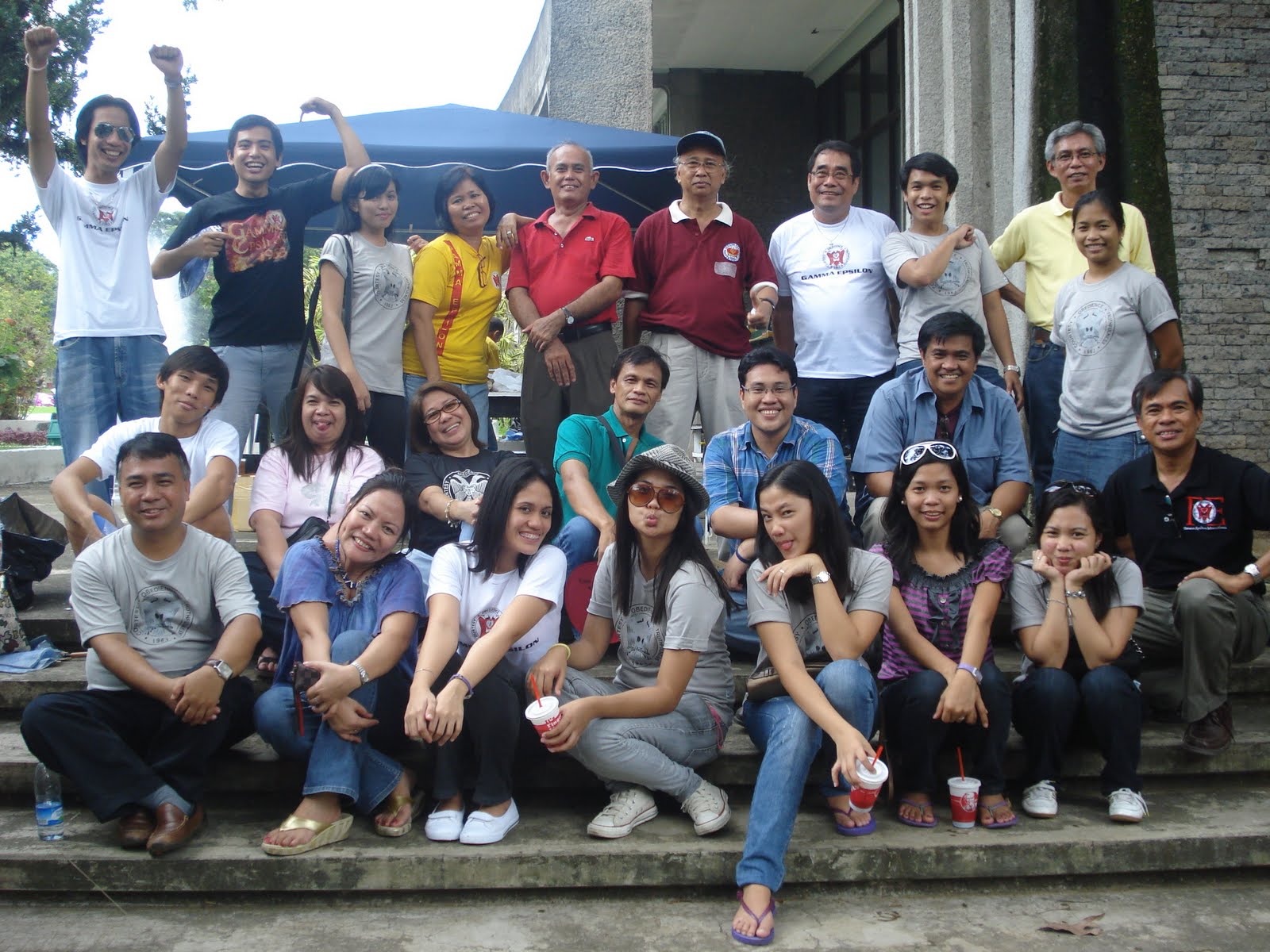
October 10 is always a special break for me, as the day is the annual celebration of UPLB Loyalty Day, my alma mater. And that's a double whammy as the Gamma Epsilon International, my fraternity affiliation scheduled its annual bonding on the same day.

I thought I am not attending this year's occasion as the 3rd GEI National Conference in Cagayan de Oro City is fast approaching, Oct. 22 - 24, 2010. But thanks God, my family (wife Rose and son Ian's family) so decided to visit UPLB too, a good timing indeed.

There's nothing so special in this year's GEI bonding. Everything goes as usual - kumustahan, chikahan among young ones, and usual beso-beso among young once. But, one not-so-"heart-aching" observation in this year's fellowship is the presence of a brother from Siniloan together with his entire family including his 2-year old daughter with hydrocaphalus. (I'll post separately how can we help this brother).

After lunch fellowship, and taking my souvenir GE T-shirt and giving my modest share in the "pass-the-hat" portion for various purposes as led by Bro. Rolly Labios (perhaps the most senior along with Bro. Hermie Esguerra, in attendance), we left UPLB reminiscing good memories of my home of 5 years which started in 1971.

To our brethren in GEI, pax et bonum, see you all in Cagayan de Oro! (Brod Josh, UPLB-Omega '72-B)

Thursday, October 07, 2010

JSF House Expands


As part of his post-retirement plan, this blogger expands his house in Sto. Tomas, San Jose City to give more space to the kitchen, home office and an azotea for general group functions, particularly for the Fellowships of brethren which the family is hosting periodically.

The upper area is an open space overlooking rice farms, and an excellent view of sunset. It is a conducive place for meditation and relaxation as well. (JSF Blogs)

Friday, September 24, 2010

PhilRice’s Field Day Series This Season Take-off


24 September 2010, Bagong Sikat, San Jose City, Nueva Ecija. The first PalayCheck Field School’s (PFS) Farmers’ Field Day and Forum (or simply Field Day) for this cropping season was conducted in this barangay today. It was participated by over 250 farmers from eight PhilRice-assisted neighboring barangays of this city, and jeep-loads of PhilRice employees, officers and guests.

PhilRice chief Atty. Ronilo A. Beronio, Congressman Joseph Gilbert F. Violago, City Mayor Marivic V. Belena and other city and provincial government officers graced the occasion with their presence and active participation.

This Field Day program is composed of invocation, singing of national anthem, messages and remarks from various local personalities, farmer-leaders, as well as from concerned PhilRice staff.

As one of the main speakers, PhilRice chief Atty. Beronio updated the crowd of the latest technologies, extension and management strategies that the Institute is adopting. He differentiated the current technology transfer used by PhilRice from the traditional or conventional way of equipping rice farmers with rice technology. For instance, PhilRice today focuses its communication campaign on the “whys” of the farm practices rather than on the “how-tos”. As a lawyer, the PhilRice chief wishes to develop our farmers, not just as technologist but also as rationale being, doing everything for a reason. To exemplify, he asked, “why should we level the field?” There must be reason/s for doing so.

The Field Day ended with free-lunch for everybody courtesy of PhilRice.

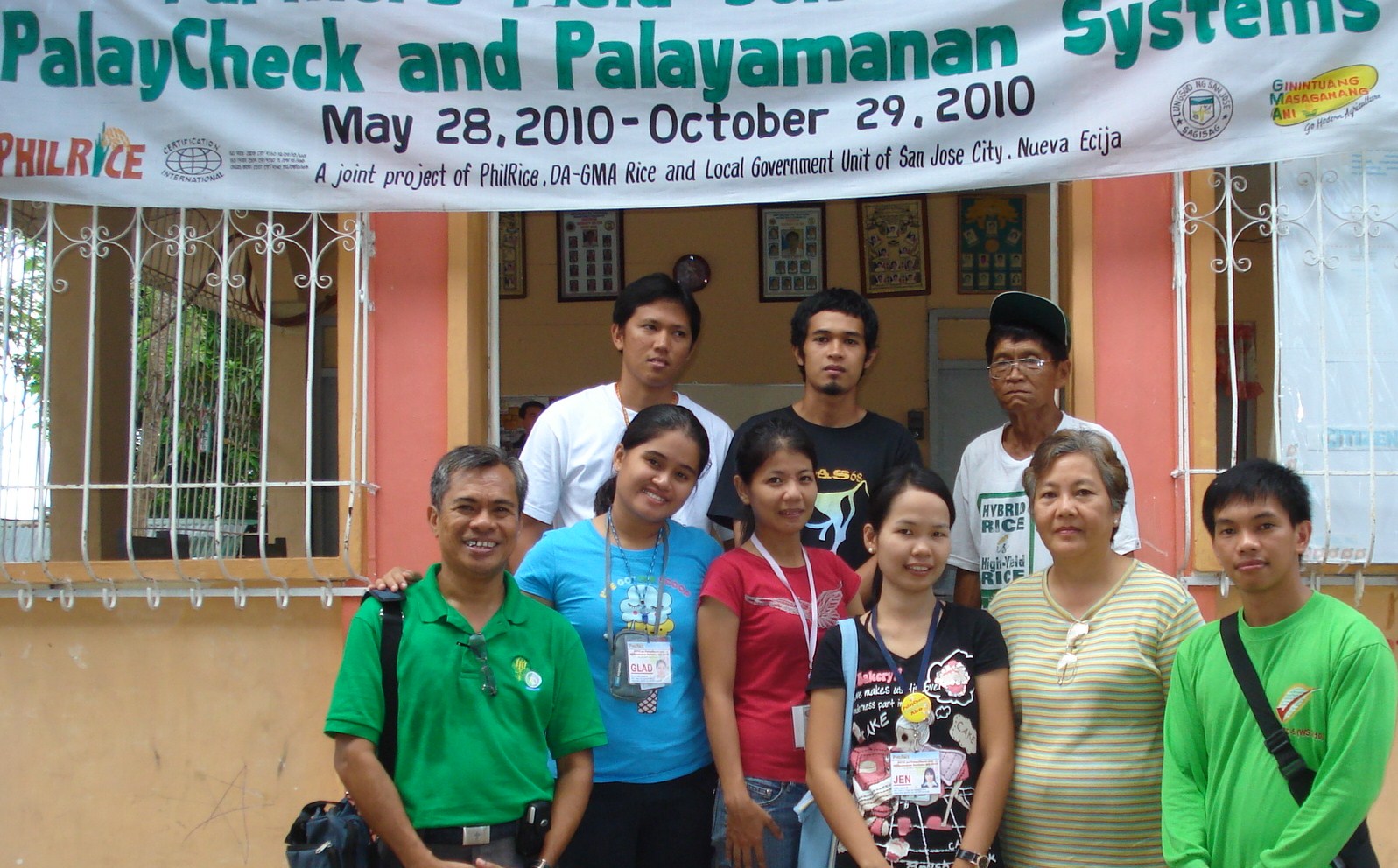
This cropping season’s Field Day series is a part of the Rice Specialists’ Training Course (RSTC) where PalayCheck Field School (PFS) is conducted in eight barangays. Each barangay has at least 25 farmers, who are provided with the latest rice production technologies. The Field Day showcases the PalayCheck system of rice production. (JSF)

Tuesday, September 21, 2010

Microteaching Exercise for 47 Rice Sufficiency Officers


This blogger has the opportunity to serve as evaluator for the microteaching exercise on Sept. 13 to 15, 2010 for the 47 RSO 6th batch of RSTC (Rice Specialists' Training Course) series.

I was really amazed, as to how well and good these RSOs did in that exercise. With a very few exceptions, I rated most of them as very satisfactory to excellent in terms of teaching skills.

The criteria used for evaluation were:

1. Mastery of the subject matter, which included competence, ability to answer questions, and ability to illustrate/emphasize key parts of the presentation.

2. Clarity of presentation and explanation, which included voice projection, mannerisms/gesturing, projected enthusiasm during the delivery, and ability to adjust to the audience’s level.

3. Effectiveness of teaching method used, to include choice of teaching methods and use of props or samples to convey the idea/message.

4. Quality of the visual aid used, to include clarity, organization and impact.

5. Rapport with participants like eye contact and enthusiasm to hear participants’ views.

I teach speech communication in a bible college, and I can’t help but compare my students with the RSOs. Among my theology students, there are many potential good materials as public speakers as they deliver sermons in a class exercise; so do with these RSOs who seem to be very knowledgeable about the principles and practice of a persuasive speech. Microteaching, just like delivering a sermon, aims at selling one’s ideas. Too, both may be categorized as salesmanship ability.

The pool of evaluators seems unanimous in concluding that this batch of 47 RSOs are now prepared and ready to face the challenge of agri-extension work with rice farming as the development strategy.(JSF Blogs)